
Diesel Technology
11 Months – Total Clock Hours: 1,106
2026 – 2027 Tuition: $13,102
Start date: 8/17/2026
Admission Requirements
Application Fee, Application, Enrollment Agreement, High School Diploma, Transcript or GED, Criminal Record Check, and Child Abuse Clearance.
Program Overview
The Diesel Technology Certificate program aims to equip adults with the academic and technical skills necessary for the heavy-duty diesel industry. It focuses on making students proficient for employment while providing a solid foundation for ongoing learning. The curriculum combines lectures, demonstrations, and hands-on experiences to cover essential diesel-related subjects such as workplace and industrial safety, tools, hardware, diesel engines, brake systems, steering, suspension, power train systems, air conditioning, hydraulics, and electrical and electronic systems.
Additionally, the program includes training in preventative maintenance and repair procedures for heavy-duty trucks and equipment, diesel shop business procedures, legal and ethical management, and communications. Graduates are prepared for entry-level positions at heavy-duty service centers as technicians, road service representatives, parts and service representatives, and customer service and public relations representatives.
Courses In This Program Include:
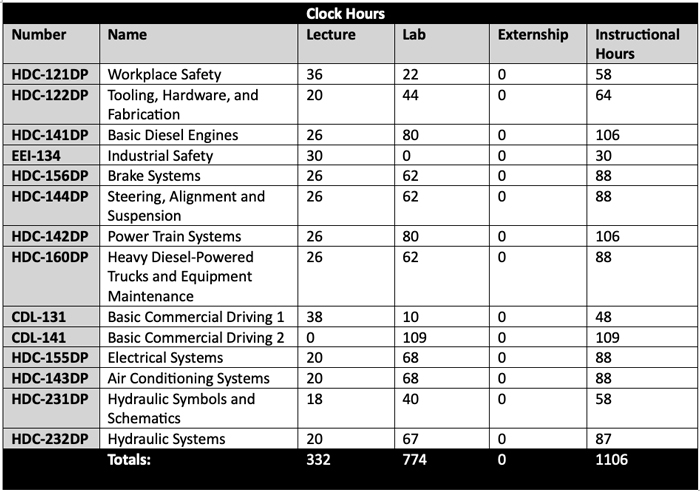
Course Descriptions
HDC-121DP: Workplace Safety
In the course Workplace Safety, students will receive an introduction to personal, environmental safety and emergency protocol procedures. Students learn the terminology associated with the Diesel profession, knowledge of teams and their assigned roles, Learning includes understanding of the state and federal safety regulation, and the names of the regulatory agencies that oversee the Diesel industry. Students will gain a basic understanding of the personal and environmental safety regulation, the proper way to Identify use the proper Personal Protective Equipment (PPE), how to Students are taught to identify and use the correct fire extinguisher Hazardous materials handling, storage, Safety Data sheet importance and interpretation, disposal procedure Safety Data sheet importance and interpretation. Students will attempt to earn up to three SP2 safety certifications. (Lecture:36.00 Hours, Lab:22.00 Hours)
EEI-134: Industrial Safety
This course provides a comprehensive understanding of industrial safety principles, focusing on workplace hazard recognition, accident prevention, and regulatory compliance. Utilizing key resources such as the Supervisors’ Safety Manual (National Safety Council, 2009), CPI Learning Resource Center’s Power Library, and Amatrol’s Industrial Safetytraining materials, students will explore essential topics including occupational safety standards, risk assessment, personal protective equipment (PPE), emergency response, and safety program implementation. The course emphasizes theoretical learning, equipping students with the knowledge to foster a culture of safety, reducing workplace incidents, and ensure compliance with industry regulations. Designed for supervisors, safety professionals, and industry personnel, this course lays the foundation for effective workplace safety management and best practices. (Lecture: 30.00 Hours, Lab: 0.00 Hours)
HDC-122DP: Tooling, Hardware, and Fabrication
This course provides an introduction tooling, hardware fabrication curriculum will prepare individuals for the use and identification used in the Heavy Diesel truck Construction equipment repair industry. It will start with basic hand tooling, air and electrical power tools, and shop tooling and end with precision measuring tools. This course also provides students with instruction on many different types of hardware found in the industry. Students will be required to identify different styles, types, and grade classifications of hardware. Additionally, this course is designed to teach students basic fabrication skills such as basic GMAW and SMAW welding, basic oxyacetylene torch set up, and cutting, grinding and cutting with an electric grinder, along with additional safety on these types of equipment. (Lecture: 20.00 Hours, Lab: 44.00 Hours)
HDC-141DP Basic Diesel Engines:
This course provides a comprehensive introduction to medium and heavy-duty diesel engines, focusing on their design, operation, and maintenance. With a combined lab and theory using the Fundamentals of Medium/Heavy Duty Diesel Engines by Gus Wright as the primary reference, students will explore essential topics such as diesel engine components, fuel and air intake systems, emissions controls, lubrication, cooling, and electrical systems. The course also covers diagnostic techniques, troubleshooting, and modern advancements in diesel engine technology. Designed for aspiring diesel technicians, mechanics, and industry professionals, this course equips learners with the foundational knowledge and hands-on skills necessary for maintaining and repairing diesel-powered vehicles and equipment. (Lecture: 26.00 Hours Lab: 80.00 Hours)
HDC -156DP Brake Systems:
This course provides an in-depth study of brake systems in heavy-duty trucks, heavy construction equipment, and agricultural machinery. Using Fundamentals of Medium/Heavy Duty Commercial Vehicle Systems (Duffy & Wright, 2016) and Fundamentals of Mobile Heavy Equipment (Duffy, Heard & Wright, 2017) as foundational texts, students will explore the principles, components, and operation of various braking systems, including hydraulic, air, and electronic braking systems. Through a combination of theoretical instruction and hands-on lab exercises, learners will gain practical experience in system diagnostics, maintenance, and repair. Emphasis will be placed on safety standards, troubleshooting techniques, and emerging technologies in brake system design. This course is designed for aspiring technicians, mechanics, and industry professionals seeking to develop a strong foundation in heavy-duty brake system operation and service. (Lecture: 26.00 Hours, Lab: 62.00 Hours)
EEI-134: Industrial Safety
This course provides a comprehensive understanding of industrial safety principles, focusing on workplace hazard recognition, accident prevention, and regulatory compliance. Utilizing key resources such as the Supervisors’ Safety Manual (National Safety Council, 2009), CPI Learning Resource Center’s Power Library, and Amatrol’s Industrial Safetytraining materials, students will explore essential topics including occupational safety standards, risk assessment, personal protective equipment (PPE), emergency response, and safety program implementation. The course emphasizes theoretical learning, equipping students with the knowledge to foster a culture of safety, reducing workplace incidents, and ensure compliance with industry regulations. Designed for supervisors, safety professionals, and industry personnel, this course lays the foundation for effective workplace safety management and best practices. (Lecture:30.00 Hours)
HDC-144DP: Steering, Alignment and Suspension
This course provides an in-depth study of steering, alignment, and suspension systems in heavy-duty trucks, heavy construction equipment, and agricultural machinery. Using Fundamentals of Medium/Heavy Duty Commercial Vehicle Systems (Duffy & Wright, 2016) and Fundamentals of Mobile Heavy Equipment (Duffy, Heard & Wright, 2017) as primary references, students will explore the principles, components, and functions of various steering and suspension systems. The course covers topics such as wheel alignment, shock absorption, stability control, and system diagnostics. A hands-on lab component allows students to apply theoretical knowledge through practical exercises, including inspections, adjustments, and troubleshooting of real-world vehicle systems. Designed for aspiring technicians, mechanics, and industry professionals, this course equips learners with the essential skills needed to maintain and repair steering, alignment, and suspension systems in heavy-duty applications. (Lecture: 26.00 Hours, Lab: 62.00 Hours)
HDC-142DP: Power Train Systems
This course provides an in-depth study of power train systems in heavy-duty trucks, heavy construction equipment, and agricultural machinery. Using Fundamentals of Medium/Heavy Duty Commercial Vehicle Systems (Duffy & Wright, 2016) and Fundamentals of Mobile Heavy Equipment (Duffy, Heard & Wright, 2017) as primary references, students will explore the design, operation, and maintenance of key powertrain components, including clutches, transmissions, torque converters, drive shafts, differentials, and final drive systems. Through a combination of theoretical instruction and hands-on lab exercises, students will develop practical skills in diagnosing, servicing, and repairing powertrain components. The course emphasizes troubleshooting techniques, emerging drivetrain technologies, and best practices for maximizing system efficiency and longevity. This course is ideal for aspiring technicians, mechanics, and industry professionals seeking to build expertise in heavy-duty powertrain systems. (Lecture: 26.00 Hours, Lab: 80.00 Hours)
HDC-160DP Heavy Diesel-Powered Trucks and Equipment Maintenance
This course provides an in-depth introduction to the maintenance and repair of heavy diesel-powered trucks and mobile-heavy equipment, with a strong foundation in both theoretical knowledge and hands-on experience. Drawing from Fundamentals of Medium/Heavy Duty Commercial Vehicle Systems (Duffy, Wright, 2016) and Fundamentals of Mobile Heavy Equipment (Duffy, Heard, Wright, 2017), students will explore the fundamental systems and components that power and control heavy-duty vehicles and equipment used in construction, agriculture, and transportation industries. Through a blend of classroom instruction and practical lab/shop work, students will gain essential skills in diagnostics, service, and preventive maintenance procedures for a variety of heavy trucks and off-road equipment. Key topics include diesel engine operation, powertrain systems, electrical systems, hydraulics, chassis and suspension, and safety practices. Emphasis is placed on developing problem-solving skills and technical competency using industry-standard tools and procedures. Students will work with real-world examples of heavy construction machinery, agricultural equipment, and heavy-duty trucks, preparing them for entry-level positions in the diesel and heavy equipment service industry or further specialized training. (Lecture: 26.00 Hours, Lab: 62.00 Hours)
CDL-131 and CDL-141: Basic Commercial Driving 1 & 2
This comprehensive course is designed to prepare students to obtain a Commercial Driver’s License (CDL) in the state of Pennsylvania, in compliance with the Federal Motor Carrier Safety Administration’s (FMCSA) Entry-Level Driver Training (ELDT) requirements. The curriculum combines theory-based instruction with practical, behind-the-wheel training to ensure students are fully equipped for both the CDL knowledge and skills tests. Using the Pennsylvania Commercial Driver’s License Manual and FMCSA-approved ELDT curriculum, students will learn the fundamentals of commercial vehicle operation, including vehicle inspection, basic control, shifting, hazard perception, and safe driving practices. Special emphasis is placed on the mastery of air brake systems and hazardous materials (HazMat) regulations, preparing students for optional endorsements that enhance job opportunities and professional credentials. The hands-on portion of the course provides real-time truck operation experience in a controlled training environment, covering skills such as backing maneuvers, turning, coupling/uncoupling, and road driving under varied conditions. Upon successful completion, students will be qualified to take the Pennsylvania CDL exams and apply for additional endorsements in Air Brakes and Hazardous Materials. (Lecture: 48.00 Hours, Lab: 109.00 Hours)
HDC-155DP Electrical Systems
This course provides a detailed study of electrical systems as they apply to heavy-duty trucks and mobile heavy equipment, combining theoretical knowledge with extensive hands-on training in a lab and shop environment. Based on the foundational texts Fundamentals of Medium/Heavy Duty Commercial Vehicle Systems (Duffy, Wright, 2016) and Fundamentals of Mobile Heavy Equipment (Duffy, Heard, Wright, 2017), students will explore core electrical principles, component functions, and diagnostic procedures essential to servicing today’s complex vehicle systems. The course covers electrical fundamentals, circuit design, wiring schematics, battery technology, starting and charging systems, lighting systems, and fault diagnostics. Using a variety of real-world equipment, including heavy construction machinery and heavy-duty trucks—students will gain experience interpreting schematics, using multimeters, and troubleshooting system faults. Students will also have the opportunity to earn industry-recognized NC3 certifications in Multimeter Usage, Battery Systems, and Starting and Charging Systems, adding value to their technical skillset and employability. (Lecture: 20.00 Hours, Lab: 68.00 Hours)